Automate Large Cash Transaction Reports (LCTRs)
From cash receipt to FINTRAC filing, without the manual work
Rhizome's FINTRAC automation files LCTRs for you, directly through FINTRAC's APIs.
Provide an API key for yourself or your clients, and we'll handle submission and store the confirmation receipt for your records.
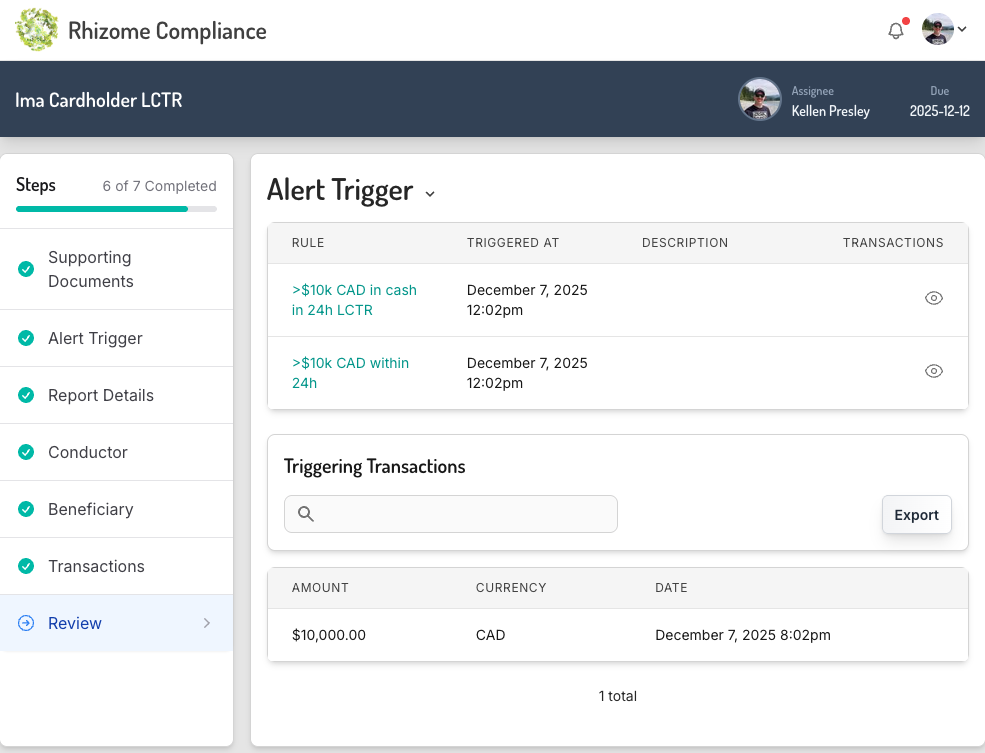
The moment a qualifying transaction hits our system, we group it into a static 24-hour window with other transactions from the same conductor, third party, or beneficiary. All available information is used to build a ready-to-submit report. Review it, then file. Whether it's cash deposits, currency exchanges, or another reportable cash transaction, the manual work disappears.
We accept your data by API, SFTP, or bulk upload, and our transaction monitor structures everything so your records stay audit-ready.
What Is an LCTR?
A $10,000 cash threshold and a 24-hour aggregation rule
A Large Cash Transaction Report (LCTR) is the report Canadian reporting entities must file with FINTRAC when they receive $10,000 CAD or more in cash in a single transaction. The obligation also applies under the 24-hour rule: when two or more related cash receipts total $10,000 CAD or more within a static 24-hour window and involve the same conductor, third party, or beneficiary, they must be reported together as one LCTR.
Cash means coins and banknotes in Canadian or foreign currency. Cheques, money orders, other negotiable instruments, and virtual currency are not cash for LCTR purposes and may be reportable under other rules. For foreign currency, the amount is converted to Canadian dollars to test the threshold. Reports are due within 15 calendar days after the day the cash is received, and a copy must be kept for at least five years.
Rhizome turns that recurring obligation into an automated workflow. Connect your transaction and customer data, let our monitoring engine identify and aggregate reportable cash activity, validate the FINTRAC fields, and file directly with the regulator. Your team reviews exceptions instead of rebuilding the same reports every day. See how our threshold reporting automation works.
How Rhizome Automates LCTR Filing
One pipeline from raw cash transaction data to a filed report
24-Hour Aggregation
Rhizome groups qualifying cash receipts by conductor, third party, and beneficiary across your defined static 24-hour window. Related transactions are combined into a single report, so several smaller receipts that together cross $10,000 CAD are not missed or filed separately.
Direct FINTRAC API Filing
Validated LCTRs are transmitted directly through FINTRAC's API. No web forms, spreadsheets, or manual re-keying. Each filing returns a confirmation receipt, and every submission, correction, and response is retained in a complete audit trail.
Validation Before Filing
Required FINTRAC fields are checked before submission, including conductor identity, transaction details, disposition, and the 24-hour aggregation fields. Missing or inconsistent data is surfaced while there is still time to fix it. Foreign-currency cash receipts are converted to CAD using the Bank of Canada rate for the transaction date, so the $10,000 threshold and reported amounts stay consistent and defensible.
Flexible Data Ingestion
Send cash transaction and customer data by API, CSV upload, or SFTP drop. Rhizome detects reportable activity from feeds you already have, then structures and validates everything needed for the filing.
From Cash Receipt to Filed Report
Four steps, fully auditable
- Ingest cash transaction and customer data from your platform, core system, or SFTP feed.
- Detect and aggregate reportable cash receipts using the $10,000 CAD threshold and your static 24-hour window.
- Validate the report, including conductor identification, third-party determination, disposition, and required FINTRAC fields.
- File directly with FINTRAC, store the confirmation receipt, and retain an audit-ready copy for at least five years.
Who Needs to File an LCTR?
Reporting entities that receive cash
LCTR obligations apply across the financial sector and beyond. They cover financial entities such as banks, credit unions, caisses populaires, trust and loan companies, life insurance companies, and securities dealers; money services businesses and foreign money services businesses; casinos; dealers in precious metals and precious stones; real estate brokers, sales representatives, and developers; accountants and accounting firms; and British Columbia notaries. Some sectors only have obligations when carrying out specific activities, and limited exceptions apply. For example, cash received from a financial entity or public body is generally not reportable. If you already file LVCTRs or EFTRs, Rhizome can run LCTR reporting through the same ingestion, monitoring, and filing pipeline. Learn more about our Canadian compliance coverage.
LCTR vs. LVCTR: What's the Difference?
Same threshold, different asset
LCTRs and LVCTRs share the same $10,000 CAD threshold and 24-hour aggregation logic, but they cover different assets. An LCTR reports cash: coins and banknotes. An LVCTR reports receipts of virtual currency. A transaction that combines both, or a customer who moves between cash and crypto, can generate separate reports. Rhizome applies the right rules to each transaction type from a single data pipeline. See how LVCTR automation works.
LCTR Frequently Asked Questions
What is an LCTR? A Large Cash Transaction Report is a report filed with FINTRAC when a reporting entity receives $10,000 CAD or more in cash in a single transaction, or in two or more related cash receipts that total $10,000 CAD or more within a static 24-hour window.
What is the 24-hour rule for LCTRs? Under the 24-hour rule, two or more cash receipts that total $10,000 CAD or more within a static 24-hour window must be aggregated into a single LCTR when the reporting entity knows they involve the same conductor, the same third party, or the same beneficiary.
When is an LCTR due? Within 15 calendar days after the day the cash is received. A copy of the report must be retained for at least five years from the date it was created.
Who has to file an LCTR? All FINTRAC reporting entities that receive cash can have LCTR obligations, including financial entities, money services businesses, casinos, dealers in precious metals and precious stones, real estate brokers and developers, securities dealers, life insurance companies, accountants, and British Columbia notaries. Sector-specific rules and limited exceptions apply.
What counts as cash for an LCTR? For LCTR purposes, cash means coins and banknotes in Canadian or foreign currency. Cheques, money orders, other negotiable instruments, and virtual currency are not cash and may be reportable under other FINTRAC rules.
Can Rhizome file an LCTR directly with FINTRAC? Yes. Rhizome validates LCTRs and transmits them through FINTRAC's API, then stores the confirmation receipt and a complete audit trail. Corrections and resubmissions use the same workflow.
Do I still need to verify identity and determine third parties? Yes. Reporting entities must verify the identity of the conductor and determine whether a third party is involved where applicable. Rhizome captures and validates those fields, but the reporting entity remains responsible for the obligation.
Can one transaction require an LCTR and another report? Possibly. A large cash receipt can also require a Suspicious Transaction Report when there are reasonable grounds to suspect money laundering or terrorist financing, and an Electronic Funds Transfer Report when the disposition involves a reportable international transfer. Rhizome lets your team escalate a threshold report to an STR in one click, carrying over the transaction, customer, and filing details so the investigation starts with the full picture.
How are foreign currency amounts converted to CAD? Rhizome uses the Bank of Canada's daily average exchange rate for the transaction date. When the Bank does not publish a rate, such as on weekends and holidays, we use the most recent prior business day.
See how Rhizome can automate your LCTR workflow, or another report or jurisdiction. In addition to FINTRAC reports, we're designed for easy filing all over the globe.