Automate Electronic Funds Transfer Reports (EFTRs)
From international transfer to FINTRAC filing, without the manual work
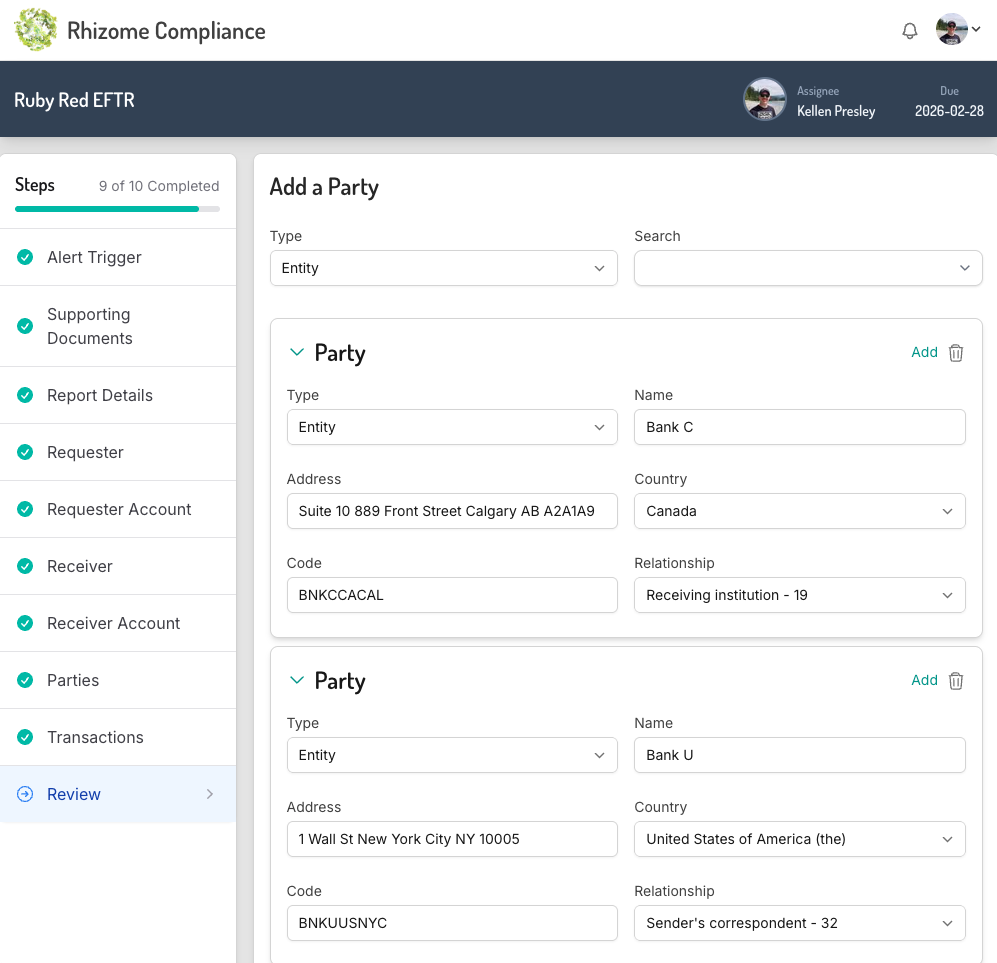
Rhizome's advanced transaction engine handles the complexity of EFTRs, especially for multi-party transactions that involve initiators, senders, requesters, and recipients, and any other parties.
Our system automatically tracks the complete transaction chain, identifying all relevant parties across jurisdictions to build accurate reports that meet regulatory requirements.
Whether it's a single initiator with multiple sending parties, complex international routing, or correspondent banks, we map the entire transaction flow. Our 24-hour aggregation applies to all related transfers, creating comprehensive reports that capture the complete picture.
Just connect your transaction data feeds or APIs, or point your core banking system's SFTP dump at us, and we'll structure, validate, and prepare all the required reports. Our system maintains complete audit trails of all cross-border electronic transfers, ensuring you're always prepared for compliance reviews.
What Is an EFTR?
A $10,000 threshold, a static 24-hour window, and five business days to file
An Electronic Funds Transfer Report (EFTR) is the report Canadian reporting entities must file with FINTRAC when they initiate or finally receive an international electronic funds transfer of $10,000 CAD or more in a single transaction. The obligation also applies under the 24-hour rule: when two or more international EFTs total $10,000 CAD or more within a static 24-hour window and involve the same requester, third party, or beneficiary, they must be reported together as one EFTR.
An international EFT is an electronic transfer of funds other than a transfer within Canada. The definition includes SWIFT MT-103 messages and non-SWIFT transfers, and SWIFT and non-SWIFT transfers must be aggregated together under the 24-hour rule. Certain transmissions are excluded, including direct deposits, pre-authorized debits, cheque imaging and presentment, beneficiary cash withdrawals, and certain internal treasury transfers. Foreign currency amounts are converted to Canadian dollars to test the threshold. Reports are due within 5 business days after the day the transfer is initiated or finally received, and a copy must be kept for at least five years.
Rhizome turns that recurring obligation into an automated workflow. Connect your transfer data, let our engine map every party in the chain and aggregate related transfers, validate the FINTRAC fields, and file directly with the regulator. Your team reviews exceptions instead of rebuilding the same reports every day. See how our threshold reporting automation works.
How Rhizome Automates EFTR Filing
One pipeline from transfer instructions to a filed report
Multi-Party Mapping
EFTRs can involve requesters, initiators, senders, intermediaries, receivers, beneficiaries, third parties, and account holders. Rhizome tracks the full chain across jurisdictions and maps each party to the correct FINTRAC field.
24-Hour Aggregation
Qualifying transfers are grouped by requester, third party, or beneficiary across your static 24-hour window. SWIFT and non-SWIFT transfers are aggregated together, so related activity is filed once and completely.
Direct FINTRAC API Filing
Validated EFTRs are transmitted directly through FINTRAC's API. No web forms, spreadsheets, or manual re-keying. Each filing returns a confirmation receipt, and every submission, correction, and response is retained in an audit trail.
Validation & Flexible Ingestion
Send transfer data by API, CSV upload, or SFTP drop. Required fields such as direction, parties, amount, currency, exchange rate, and aggregation details are checked before filing, so gaps surface while there is still time to fix them. Foreign-currency transfers are converted using the Bank of Canada's daily CAD rate for the transaction date, including the prior business day for weekend and holiday transactions.
From Transfer to Filed Report
Four steps, fully auditable
- Ingest transfer data and party details from your platform, core system, or SFTP feed.
- Identify reportable international EFTs and aggregate related transfers using the $10,000 CAD threshold and your static 24-hour window.
- Map every requester, sender, receiver, beneficiary, third party, and account holder, then validate the required FINTRAC fields.
- File directly with FINTRAC, store the confirmation receipt, and retain an audit-ready copy for at least five years.
Who Needs to File an EFTR?
Reporting entities that initiate or finally receive international transfers
EFTR requirements apply to financial entities, money services businesses and foreign money services businesses, and casinos when they initiate or finally receive a reportable international EFT. Life insurance companies, brokers, and agents can also be financial entities for EFTR purposes when they offer certain loans or prepaid payment products. Intermediaries that only pass on a transfer may not have to file the EFTR, but they still have record-keeping and travel-rule obligations. If you already file LCTRs or LVCTRs, Rhizome can run EFTR reporting through the same ingestion, monitoring, and filing pipeline. Learn more about our Canadian compliance coverage.
EFTR vs. LCTR vs. LVCTR: What's the Difference?
Same threshold, different transaction type
EFTRs, LCTRs, and LVCTRs all use a $10,000 CAD threshold and static 24-hour aggregation, but they report different things. An EFTR reports international electronic funds transfers. An LCTR reports cash receipts. An LVCTR reports virtual currency receipts. A single transaction can trigger more than one: for example, a customer who pays $10,000 in cash and asks you to send an international transfer may require both an LCTR and an EFTR. Rhizome applies the right rules to each transaction type from one pipeline. Learn about LCTR automation or LVCTR automation.
EFTR Frequently Asked Questions
What is an EFTR? An Electronic Funds Transfer Report is a FINTRAC report for an international electronic funds transfer of $10,000 CAD or more that a reporting entity initiates or finally receives.
What is the 24-hour rule for EFTRs? Under the 24-hour rule, two or more international EFTs that total $10,000 CAD or more within a static 24-hour window must be aggregated into a single EFTR when they involve the same requester, the same third party, or the same beneficiary. SWIFT and non-SWIFT transfers must be aggregated together.
When is an EFTR due? Within 5 business days after the day the transfer is initiated or finally received. A copy of the report must be retained for at least five years from the date it was created.
Who has to file an EFTR? Financial entities, money services businesses and foreign money services businesses, and casinos must file EFTRs when they initiate or finally receive a reportable international electronic funds transfer.
What counts as an international EFT? An international EFT is an electronic transfer of funds other than a transfer within Canada. It includes SWIFT MT-103 messages and non-SWIFT transfers. Certain transmissions are excluded, including direct deposits, pre-authorized debits, cheque imaging and presentment, beneficiary cash withdrawals, and certain internal treasury transfers.
Does Rhizome handle multi-party transfers? Yes. Rhizome maps the full transfer chain, including requesters, initiators, senders, intermediaries, receivers, beneficiaries, third parties, and account holders, then builds the report from the complete set of party information.
Can Rhizome file an EFTR directly with FINTRAC? Yes. Rhizome validates EFTRs and transmits them through FINTRAC's API, then stores the confirmation receipt and a complete audit trail. Corrections and resubmissions use the same workflow.
Can an EFTR also require another report? Yes. A cash-funded international transfer may require both a Large Cash Transaction Report and an EFTR, and suspicious activity may require a Suspicious Transaction Report. Different report types are triggered by different facts, and the same transaction can require more than one filing.
How are foreign currency amounts converted to CAD? Rhizome uses the Bank of Canada's daily average exchange rate for the transaction date. When the Bank does not publish a rate, such as on weekends and holidays, we use the most recent prior business day.
Beyond standard EFTRs, we specialize in complex multi-jurisdictional transaction reporting. See how Rhizome can automate your EFTR workflow, or another report or jurisdiction. In addition to FINTRAC reports, we're designed for easy filing all over the globe.